SEO for Plumbers: How to Rank Higher on Google & Get More Customers Online
Plumbing might happen in the real world, but 90%+ of customers search online first when they need a plumber.


Gone are the days of flipping through phone books – today almost half of all Google searches are for local services (34 Eye-Opening Google Search Statistics for 2025). If your plumbing business isn’t showing up when locals search “plumber near me,” you’re missing out on a flood of new customers. The good news? With the right SEO strategies, even a one-person plumbing shop can rank on the first page and keep the phone ringing.
In this guide, we'll break down exactly how to improve your plumbing website’s visibility on Google. You'll get simple, actionable tips to boost your local presence, optimize your website, and ultimately get more plumbing leads – all without needing technical expertise. (And if you don’t have the time or budget for a fancy website, stay tuned for a smart AI tool that can build an SEO-friendly site for you.) Let’s dive in!
What You’ll Learn:
What “Plumber SEO” Means and Why It Matters – Understand how SEO drives free leads and why 91% of people never go past page 1 ([91.5% of People Never Click on the Second Page of Google](https://reputation911.com/do-people-click-past-the-first-page-of-google/#:~:text=Most%20people%20never%20bother%20clicking,page%20of%20Google%20search%20results)).
7 Essential SEO Strategies for Plumbers – Step-by-step tactics covering Google Business Profile, website optimization, content, and more.
Pro Tips for More Calls & Customers – Actionable insights on keywords, reviews, local directories, and link building that your competitors might be missing.
Common Mistakes to Avoid – SEO pitfalls (like keyword stuffing or cheap tricks) that could hurt your rankings.
FAQ & Next Steps – Quick answers to plumbers’ top SEO questions, and a peek at an AI website builder that can do the heavy lifting for you.
Ready to rank higher and outshine other plumbers in your area? Let’s get started!
What Is “SEO for Plumbers” (and Why Should You Care)?
SEO (Search Engine Optimization) for plumbers means optimizing your online presence so that your business appears at the top of search results when someone in your area looks for plumbing services. It’s not magic or tech voodoo – it’s a mix of best practices that help Google find your business, trust your website, and show it to people searching for what you offer. In practical terms, plumber SEO includes things like: making sure your website is fast and full of relevant info, using the right keywords (e.g. “emergency plumber in [Your City]”), getting positive customer reviews, and listing your business on Google and other directories.
Why does this matter? Because people rely on Google (and Bing, etc.) to find local services. If your website and business profiles are properly optimized, you can skip expensive ads and let customers come to you organically. For example, “plumbers near me” is searched roughly 246,000 times per month in the U.S. (SEO for Plumbers: How to Rank Higher & Get More Customers) – that’s a huge pool of potential clients. Ranking high for those kinds of searches means a steady stream of calls without paying for ads on each click.
On the flip side, if your website is buried on page 2 or beyond, hardly anyone will find you. Studies show 91.5% of users stay on the first results page (91.5% of People Never Click on the Second Page of Google) (often, they don’t even scroll past the top few results). In one survey, over 99% of people said they use the internet to find local businesses (SEO for Plumbers: Marketing Guide 2025) – and almost no one is checking the second page of Google. The takeaway? SEO is your ticket to visibility. It puts your plumbing business where your customers are looking.
By investing a bit of time into SEO, a plumber can leapfrog larger competitors on Google, build trust with customers, and generate leads 24/7. In the next sections, we’ll cover exactly how to do that, step by step.
7 Essential SEO Strategies for Plumbers to Rank Higher
To outrank other plumbers and attract more customers online, focus on these seven core areas. Tackle these one by one, and you’ll build a strong online presence that drives consistent leads.
1. Set Up and Optimize Your Google Business Profile
When it comes to local SEO, Google Business Profile (GBP) is priority #1. This is the free listing that lets your plumbing business show up in Google Maps and the local “3-pack” results (the map and 3 businesses that often appear above regular search results). For local searches like "plumber near me" or "plumber in [City]," the Google Business listing is often the first thing people see – so you want to be there.
Action Steps:
Claim or Create Your Profile: Go to Google Business Profile (formerly Google My Business) and claim your business. Fill out every section with accurate details – business name, address, phone (your NAP info), website, hours, etc. Choose the most appropriate categories (e.g. Plumber, Plumbing, etc.). This helps Google know what searches you should rank for ([SEO for Plumbers: How to Rank Higher & Get More Customers](https://backlinko.com/seo-for-plumbers#:~:text=,Google%20Business%20Profile)).
Add Service Areas: For plumbers who travel to customers, list the cities/neighborhoods you serve. This improves your chances of appearing for searches in those locales.
Write a Keyword-Rich Description: In your business description, mention your key services and city. For example: “Full-service plumber in Houston specializing in emergency repairs, water heater installation, and leak detection.” Don’t stuff keywords unnaturally, but do include important terms (services, city names) that potential customers search.
Upload Photos: Add high-quality photos of your team, your logo, your truck, and even before/after shots of your work. Businesses with photos tend to get more clicks and calls. Showcasing your friendly face or branded vehicle can also build trust.
Once your profile is set up, keep it active. Post updates occasionally (seasonal tips, special offers), and most importantly – collect reviews (more on that next). An optimized Google Business Profile signals to Google that you’re a relevant, legit plumbing business, boosting your chances of showing up in that coveted Map Pack (SEO for Plumbers: How to Rank Higher & Get More Customers) (SEO for Plumbers: How to Rank Higher & Get More Customers).
> Pro Tip: Ensure your business Name, Address, Phone (NAP) on Google Business Profile exactly matches what’s on your website and other listings. Consistent NAP info across the web boosts your local SEO credibility.


2. Encourage Glowing Customer Reviews ⭐️
Reviews are gold for a local service business like plumbing. Not only do prospective customers heavily rely on star ratings and testimonials to decide whom to call, but Google’s algorithm also uses reviews as a ranking factor for local results ([SEO for Plumbers: How to Rank Higher & Get More Customers](https://backlinko.com/seo-for-plumbers#:~:text=match%20at%20L653%20,and%20Manage%20Online%20Reviews)). In short, more (and better) reviews = higher rankings in many cases.
Focus on Google reviews (the ones that show on your Google Business Profile), but also consider other platforms like Yelp, Facebook, or HomeAdvisor relevant to your area. Here’s how to boost your review profile:
Ask (Politely) for Reviews: After completing a job for a happy customer, ask them for a review. A simple request like, “If you don’t mind, could you leave a quick review about our service on Google? It helps a lot!” works wonders. Most satisfied customers are willing – they just need a nudge and a direct link to your review page.
Make It Easy: Send a follow-up text or email with a direct link to your Google review form. The less effort required, the more likely they’ll do it. You can find your review link in your Google Business dashboard (under “Get more reviews”).
Respond to Reviews: Engage with every review, good or bad. Thank people for positive feedback. For any negative reviews (they happen to everyone), respond calmly and professionally, showing future readers that you care and resolve issues. Google likes to see business owners active and responsive.
Leverage Happy Customers: If someone sends you a kind text or email about your work, reply and ask if they’d share that experience in an online review. Sometimes a gentle reminder is all that’s needed.
Why go to all this trouble? Because reviews not only improve SEO, they also convert leads. A high average rating and recent positive comments can tip a potential customer in your favor. In fact, 84% of people trust online reviews as much as personal recommendations, according to BrightLocal surveys (SEO for Plumbers: Marketing Guide 2025). And higher-rated businesses tend to get clicked more in Google’s local results, which in turn improves your ranking further – a virtuous cycle!
Quick Tip: Don’t offer incentives for reviews – it’s against Google’s guidelines. Simply provide great service and kindly ask. Over time, aim for a steady stream of new reviews. Consistency matters; fresh reviews show you’re active. Even a few new reviews each month will keep your profile looking active to Google’s eyes (and customers’ eyes).
3. List Your Business in Online Directories (Citations)
Aside from Google’s own platform, you’ll want to ensure your plumbing business is listed on other popular directories and map services. In SEO lingo, these listings are called citations – mentions of your business name, address, and phone on other websites. Citations in reputable directories boost your local credibility and can directly send you leads as well.
Important places to list your plumbing business include:
Yelp: A major directory for local services. Many people search Yelp for plumbers, and Yelp pages can rank in Google too. Create or claim your Yelp page, fill it out thoroughly, and keep info updated.
Bing Places: Not everyone uses Google – some use Bing or Cortana, which pulls from Bing Places. It’s easy to set up (you can often import your Google Business info).
Other Directories: Consider Angi (Angie’s List), HomeAdvisor, Thumbtack, YellowPages.com, and any local-city business directories or chamber of commerce listings. Also, Apple Maps (through Apple Business Register) is increasingly important for iPhone users’ local searches.
Industry-Specific Sites: If there are plumbing-specific directories or associations (e.g. if you’re part of the BBB or a plumbing trade organization list), make sure you’re listed there too.
When adding your business, keep your NAP details identical everywhere. (If your address is “Suite 200” on one site, don’t write “Ste 200” on another – use one format.) This consistency helps search engines confidently link those citations to your business.
Also, include your website link on each listing. These links from directory sites act as backlinks (which help SEO – more on that later) and drive referral traffic. Many homeowners might find you via a Yelp search or an Angi browse and then click to your website or call directly from that platform.
Yes, managing multiple listings can be a hassle, but you don’t have to tackle them all at once. Start with the big ones (Google, Yelp, Bing, Facebook). You can also use services or tools (like Moz Local, BrightLocal or Semrush’s listing management) to sync info across many directories at once. It’s worth the effort: consistent and widespread citations signal to Google that you’re a real, established business, which can boost your local search rankings.
Bonus: Many directory sites themselves rank high on Google. For example, Yelp often appears on page 1 for local searches. Having a presence there gives you another chance to capture a click. It’s like fishing with multiple lines in the water – you increase your odds that a searching customer finds your business.
4. Optimize Your Website’s On-Page SEO (Keywords & Content)
Your website is your online storefront – and for SEO, it’s the foundation that everything else builds on. On-page SEO refers to optimizing the content and HTML of your site so that search engines understand it and rank it for the right searches. Here’s how to make your plumbing website search-friendly:
Do Keyword Research: Think about what your customers search for – not just “plumber [City]” but all the related terms. Use free tools like Google’s Keyword Planner or a trial of Ahrefs/SEMrush to find high-volume keywords relevant to your services. For instance, you might discover terms like “water heater repair [City]” or “emergency plumber 24/7” get a lot of searches. Make a list of these target keywords. (Tip: Also include long-tail phrases like “clogged drain home remedy” for blog content ideas – more on content in the next section.)
Now, optimize your pages around those keywords:
Create Dedicated Service Pages: Ensure your website has a separate page for each main service you offer (e.g. Water Heater Repair, Drain Cleaning, Leak Detection, etc.). It’s easier to rank when each page is clearly about a specific topic. For example, a “Water Heater Repair in [City]” page can target that exact phrase in its title and content, making it super relevant to someone searching it.
Use Keywords in Key Places: For each page, include your target keywords in the page title, H1 heading, and a couple of times in the body content (especially in the first paragraph if natural). For example, your homepage title might be “[City] Plumber | 24/7 Plumbing Services & Repairs” – covering “plumber” and maybe “plumbing services [City]”. Don’t overdo it – aim for a natural feel. Google is smart about synonyms, so also use variations (e.g. “plumbing company”, “plumbing contractor”).
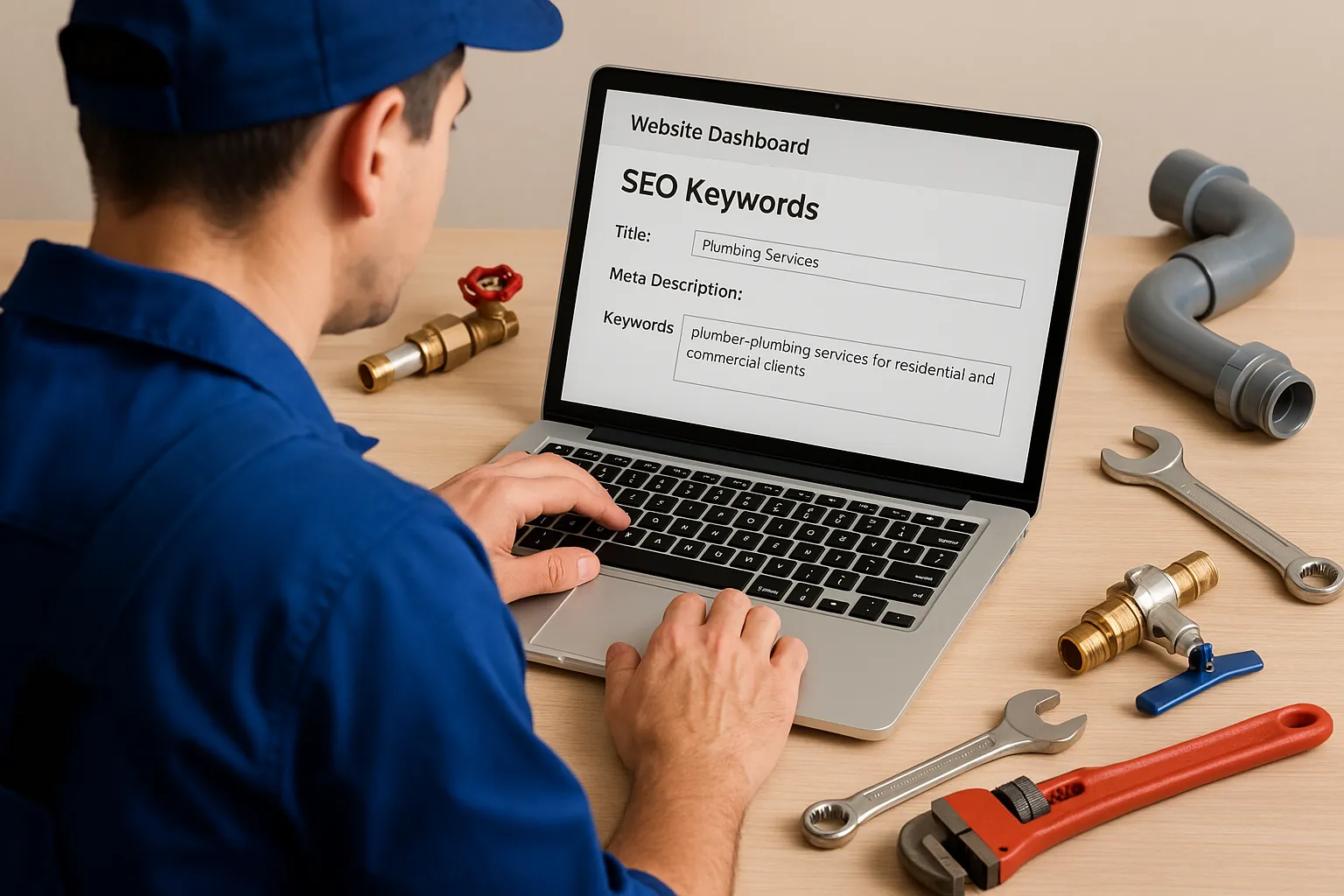
Write a Compelling Meta Description: This is the snippet of text that appears below your link in Google. While not a direct ranking factor, a good meta description can improve your click-through rate (CTR), which is a ranking factor. In ~155 characters, summarize the page and include a call to action. Example: “Need a reliable plumber in Dallas fast? Our licensed team offers emergency repairs, water heater service, drain cleaning and more. Call now for a free quote!”. Include one primary keyword (“reliable plumber in Dallas”) so it bolds in the search results, and entice the reader (CTA like “Call now for a free quote”).
Header Tags and Content: Break up your text with descriptive headings (H2, H3 tags) that include keywords or related terms. For instance, on a Drain Cleaning page, an H2 might be “Professional Drain Cleaning in Dallas – Fast Removal of Clogs.” This not only helps SEO but makes it easier for customers to scan. Keep paragraphs short (like we’re doing in this article) and use bullet points for lists of services or benefits.
Optimize Images: Add photos of your work or team on your site. Make sure to give the image files a descriptive name (`dallas-water-heater-repair.jpg` instead of `IMG001.jpg`) and fill out the alt text with a description (e.g. alt="Plumber repairing a water heater in Dallas home"). Alt text helps search engines understand images and can slightly boost your keyword relevance. It also makes your site accessible for visually impaired users – a nice bonus.
Include Location Info: For local SEO, sprinkle your city (and nearby service areas) naturally into your page content. For example: “We proudly serve homeowners throughout Dallas, including Plano, Richardson, Garland, and other Metroplex areas.” This helps you show up for searches in those areas and signals your local relevance.
Quality matters: While optimizing for keywords, don’t forget you’re writing for humans first. Google’s algorithms reward helpful, trustworthy content. So provide value – explain your services, answer common customer questions on the page, and demonstrate expertise (mention your years of experience, licenses, guarantees, etc.). Not only does this help with Google’s E-E-A-T (Experience, Expertise, Authoritativeness, Trustworthiness) guidelines, it also converts visitors into callers by building trust.
If you implement the on-page tips above, your site will be far more “understandable” to search engines. For example, Google sees a page title “Drain Cleaning in Denver – XYZ Plumbing” and knows exactly what that page is about and who might find it useful. Combine that with solid local signals (like your GBP and citations), and you’ve greatly improved your chances of ranking on page 1 when someone searches those services.

5. Improve Your Site’s Speed and Technical Health (Technical SEO)
Ever clicked on a site that took forever to load? You probably hit the “back” button pretty fast. Your potential customers would do the same. Website speed and technical setup play a big role in both user experience and SEO rankings. Google wants to show sites that load fast, look good on mobile, and are secure, because that means better experience for users. Let’s ensure your site checks those boxes:
Boost Your Page Speed: Fast-loading pages are crucial. In fact, if a site takes more than 3 seconds to load, over half of users will abandon it. Use free tools like Google PageSpeed Insights or GTmetrix to test your site. These will give you specific suggestions. Common fixes include compressing images (make large photos smaller in file size), enabling browser caching, and minimizing code. If you’re not techy, ask your web developer for help, or if you’re using WordPress, install a caching plugin and image optimization plugin – they can greatly speed things up.
Mobile-Friendly Design: More than 60% of searches are on mobile devices now ([34 Eye-Opening Google Search Statistics for 2025](https://www.semrush.com/blog/google-search-statistics/#:~:text=Google%20Statistics%20Highlights)) ([34 Eye-Opening Google Search Statistics for 2025](https://www.semrush.com/blog/google-search-statistics/#:~:text=4.%2063,S)), and Google primarily uses the mobile version of your site for indexing (called mobile-first indexing ([34 Eye-Opening Google Search Statistics for 2025](https://www.semrush.com/blog/google-search-statistics/#:~:text=Desktop%20devices%20no%20longer%20account,has%20updated%20its%20systems%20accordingly))). So your site must look and work great on phones. Use Google’s Mobile-Friendly Test to check. Ensure text is readable without zooming, links/buttons are tappable, and content isn’t cut off. A responsive website design (which adapts to screen size) is a must. If your site isn’t mobile-friendly, that’s priority to fix – both for SEO and for keeping users happy.
Use HTTPS (SSL Encryption): If your website URL still starts with `http://` instead of `https://`, it’s time to get an SSL certificate. HTTPS is the secure version of HTTP, and Google gives a slight ranking boost to secure sites. Plus, modern browsers will show a “Not Secure” warning on non-HTTPS sites, which can scare visitors away. Most web hosts provide free Let’s Encrypt SSL certificates that are easy to activate. Once HTTPS is enabled, redirect all old http links to the new https versions.
Fix Technical Errors: Little behind-the-scenes issues can hurt SEO. Use a tool like Google Search Console (free to set up for your site) to spot errors. Look for things like broken links or 404 pages (if you moved or deleted a page, set up a redirect to a relevant page so you don’t lose any “link juice” from other sites linking to it). Ensure you have a robots.txt file (to guide search engines what to crawl) and an XML sitemap listing your pages (which you can submit in Search Console to help Google find all your pages). These technical details help ensure Google can crawl and index your site efficiently.
Implement Schema Markup: This is a more advanced tip, but worth mentioning. Schema markup is code you add to your site to give search engines extra info, like your business type, reviews, services, etc. For local businesses, using LocalBusiness schema can reinforce your NAP, opening hours, etc., to Google. There are free schema generator tools (Google offers one) where you fill in details and get JSON-LD code to paste into your site. While schema alone isn’t a magic ranking boost, it can enhance how your listing appears (for example, getting star ratings to show if you integrate reviews on your site) and give clearer context about your business. Consider adding at least your basic Business schema on your homepage.
In short, think of technical SEO as tuning up your plumbing truck – it’s not as flashy as a new tool, but without maintenance it could break down on the job. A well-structured, speedy, mobile-optimized, error-free site creates a smooth experience for users and sends Google all the right signals. This lays the groundwork so that all the content and keywords from step 4 can truly shine.
Quick Check: Run your site through Google’s tools (Search Console, PageSpeed Insights, Mobile-Friendly Test). They’re free and will list out any critical issues. Fixing even a couple of technical snags or slowness issues could bump up your rankings and will definitely improve user satisfaction.
6. Create Helpful Content (and FAQs) to Attract Customers
Beyond your core service pages, having additional quality content on your site can really amplify your SEO. Why? Because every extra page is another opportunity to rank for a related search, and great content builds your authority. Many plumbers overlook this, but content marketing is a secret weapon to pull in leads who aren’t yet calling a plumber but will need to.
Consider adding a blog or learning center on your site where you post articles, how-tos, or answers to common questions. Some content ideas that work well for plumbing:
“How-To” Guides: Home improvement DIYers often search things like “how to fix a running toilet” or “how to unclog a drain naturally.” If you write a helpful article or make a checklist, you can attract those visitors. While many will try to DIY first, guess who they might call when they give up or if the problem is too big? That’s right – the helpful plumber whose site they visited. You’ve built trust by sharing your expertise freely. For example, a post titled “How to Unclog a Stubborn Drain (Plus When to Call a Plumber)” can both help the reader and subtly encourage them to call if it’s beyond them (and you can mention your drain services within).
FAQs and Problem Explanations: Think of questions customers ask you on the job: “Why is my water heater making noise?”, “What’s the best way to prevent frozen pipes?” Create a blog post or FAQ page for those. Not only does this content target long-tail searches, it also shows site visitors that you know your stuff. Include local terms if appropriate (like “winter in Chicago” for frozen pipe advice in Chicago).
Cost and Service Comparison Posts: Many people search for info on pricing or options, e.g. “Tankless vs Traditional Water Heater” or “How much does it cost to replace a water heater in [City]?”. You can write posts explaining those with general price ranges. These are fantastic for capturing people before they’ve chosen a plumber. If you provide honest, useful info (and maybe a gentle pitch for your services), you’re positioning yourself as the trustworthy choice.
Maintenance Tips: Offer seasonal tips (spring plumbing checklist, preparing pipes for winter) or general maintenance advice (like “5 Things You Should Never Flush”). This kind of content can get shared on social media or linked by others, which helps your SEO authority.
When creating content, optimize it just like your other pages: use relevant keywords in the title and headings (e.g., an article “Why Is My Water Pressure Low?” might target that exact question as the title). Also, link to your own pages where relevant – if you mention water heater repair in a blog post about water heaters, link those words to your water heater service page. This internal linking helps spread SEO value around your site and guides readers to your service pages.
Don’t worry that giving away free tips will reduce calls. On the contrary, it often builds trust. Homeowners will see that you’re knowledgeable and helpful, and many will decide they’d rather have you handle it. Plus, great content can earn you backlinks (for example, a local news site might link to your “10 ways to save water” article, or someone on a forum might share your pipe maintenance guide). Those backlinks further boost your site authority.
Lastly, consider adding a FAQ section on your site (or on relevant pages) with common plumbing questions. This can even snag you a featured snippet or a spot in Google’s “People Also Ask” results if done well. Marking up FAQs with FAQ schema can sometimes make them show up enhanced in search results. For instance, on your drain cleaning page, a short FAQ like “Q: Can I use chemical drain cleaners? A: They can provide a temporary fix, but they often damage pipes… (etc)” could target that question’s keyword and provide value.
The key is to make your site a helpful resource. Many of your competitors will only have a basic “About Us” and “Services” pages. By having a blog with useful posts and answers, you stand out. Google tends to favor sites that demonstrate expertise and depth. And even if readers don’t convert immediately, you’ve made an impression. They might bookmark your guide or remember your company name when they do need a plumber.

7. Build Quality Backlinks and Local Partnerships
In the world of SEO, backlinks – links from other websites to yours – are like votes of confidence. When reputable sites link to your plumbing website, Google sees that as a signal of trust and authority, which can boost your rankings. For a local business, you don’t need hundreds of backlinks, but a few high-quality links can make a big difference. Here are ways to earn them:
Local Partnerships & Sponsorships: Think about your connections in the community. Did you sponsor the local Little League or participate in a charity event? See if they’ll link to your site from a sponsors or partners page. If you’re friendly with nearby businesses (e.g. a hardware store, real estate agency, etc.), you could do a “local businesses we trust” swap of links or guest posts. For example, a realtor might have a blog where you contribute “5 Plumbing Upgrades That Increase Home Value,” and in return you link to them on your site – a win-win.
Get Listed in Local News or Blogs: If you do something newsworthy (even a human-interest story like helping out a customer in need or running a free workshop on preventing plumbing disasters), send a press release or simply contact the local news or community blogs. A mention with a link from the local newspaper site or a popular community blog is fantastic for local SEO authority. Even without a major story, you could offer to write a column with home maintenance tips for a local site or magazine.
Write Guest Articles: Identify home improvement or trade websites where you could contribute an article. For instance, a home DIY blog might love a piece like “Top 5 Plumbing Fixes Homeowners Can Do Themselves (and 3 They Should Leave to the Pros).” In your author bio, you get a link back to your site. This positions you as an expert and gives you a relevant backlink. Just target credible sites (ideally those related to home services or local to your region) – a few good links beat dozens of low-quality ones.
Leverage Supplier Relationships: Are you a certified installer for a certain brand of water heater or fixture? Many manufacturers or distributors have directories of authorized service providers – ensure you’re listed and that they link to your site. Or write a testimonial for a supplier or tool you use; companies often showcase testimonials with a link to your business.
Online Forums & Q&A (sparingly): Sometimes you can drop a helpful answer on platforms like Quora or a local Facebook group when people ask plumbing questions, and include your website link in your profile or answer source. Do this primarily to be helpful – blatant link dropping can come off as spammy. But if you genuinely assist someone and reference an article on your site, it can drive a few visits and possibly a link.
Remember, quality over quantity. A single link from a respected site (say a city Chamber of Commerce or a well-known home improvement blog) outweighs 50 links from random low-tier directories or comment sections. Be wary of anyone selling backlinks – Google is very good at catching paid or spam links and can penalize sites that use them. Focus on earned links through relationships and good content.
Additionally, maintain the citations we talked about (those count as links too). If you discover mentions of your business online that aren’t linked (like someone wrote about “We used XYZ Plumbing and they did great” but didn’t hyperlink it), you can politely reach out and ask if they’d mind linking the mention to your site (this is called link reclamation).
Finally, as your content strategy grows, some of your blog posts might naturally attract backlinks. For example, if your “How to winterize home plumbing” guide is really good, other websites or bloggers might reference and link to it over time. You can accelerate this by sharing your content on social media or in networking groups.
To track backlinks and discover opportunities, tools like Ahrefs or Ubersuggest can show you which sites link to you and even what links your competitors have (so you can target similar sources). For instance, if you see a competitor got mentioned on a local radio station’s website, maybe you can reach out to that station with your own tips segment.
Building a network of quality backlinks doesn’t happen overnight, but each link is a lasting asset that boosts your SEO “strength.” Even just a handful of solid links can elevate your site’s authority above other local plumbers who have none. It’s like having reputable friends vouch for you – it makes Google more confident to recommend your business at the top of the results.
Avoid These Common Plumbing SEO Mistakes
Now that you know what to do, it’s worth noting a few SEO pitfalls to avoid. These mistakes won’t help your rankings – in fact, they could hurt your visibility or even get your site penalized by Google. Steer clear of these:
❌ Keyword Stuffing: Jamming every possible keyword into your pages (“If you need a plumber in Dallas, call our Dallas plumbing company for the best Dallas plumbers in Dallas!”) makes for a terrible read and signals to Google that you’re trying to game the system. Use keywords naturally and in moderation. Google’s algorithms are smart – they understand context. Focus on providing value in your copy. Overusing keywords can actually hurt your rankings, as Google may flag the page as low-quality.
❌ Buying Cheap Backlinks: It might be tempting to buy a package of “1000 backlinks for $50,” but these are usually spam links from unrelated or low-quality sites. Google has algorithms (like Penguin) that detect manipulative link schemes and can penalize or de-rank your site. It’s not worth the risk. The best links are earned, not bought. If an SEO agency promises hundreds of links overnight, that’s a red flag. Aim for natural link building (refer back to strategy #7).
❌ Duplicate Content: Using the same content on multiple pages (or copying from a competitor’s site) can backfire. For example, don’t create 10 doorway pages for 10 different suburbs that all have the same text just swapping city names – Google may only index one and ignore the rest, or view it as a thin content tactic. Always try to write original content for each page. If you serve multiple areas, a better approach is one main service page and a concise section listing service areas, or unique content on each city page if you make them.
❌ Neglecting Mobile Users: As mentioned, a site that isn’t mobile-friendly is a deal-breaker today. If visitors on phones have a bad time (pinching to zoom, broken layout), not only will they leave, but Google might demote your site in mobile search results. Avoid heavy reliance on Flash or old site designs that don’t adapt to mobile. Make sure phone users can navigate easily – especially since many will be literally trying to call you from their phone after finding you!
❌ Ignoring Analytics: This is less a “penalty” risk and more a missed opportunity. If you’re not looking at any data, you won’t know what’s working. Set up Google Analytics and Search Console. They’re free and show which pages get traffic, what queries you’re showing up for, and more. For instance, Search Console might reveal you get a lot of impressions for “sump pump repair [City]” but not many clicks – maybe because you don’t have a dedicated page for that. Without checking, you’d never know. Don’t fly blind; use data to continually tweak your SEO strategy.
❌ Black-Hat Tricks: Be wary of any “too good to be true” trick. This includes things like hidden text (e.g. listing a bunch of keywords in white text on a white background – yes people try this), doorway pages, or automatically generated content. These tactics violate Google’s guidelines and can result in your site being penalized or removed from search results. Stick to the legitimate tactics we covered – they might be slower, but they build long-term ranking power.
In short, think like Google: they want to show the user the best, most relevant results. If you try to cheat or serve thin content stuffed with keywords, it won’t benefit the user – and Google will eventually catch on. Focus on genuinely improving your site and online presence; you’ll be rewarded with better rankings that last.
If you avoid these mistakes and stick to the strategies in this guide, you’ll be ahead of most local competitors who might be making some of these errors. SEO is as much about playing by the rules as it is about optimization.
Work Smarter: Leverage AI Tools (Websites & SEO Tags with Zero Coding)
By now you might be thinking, “This is great info, but it’s a lot to handle on my own.” If you’re a busy solo plumber or small operation, implementing all these SEO steps can feel overwhelming. This is where technology can give you a boost. Enter AI-powered website builders – tools that can create and optimize your website for you, so you can focus on running your business.
One such tool is Pineapple Builder, an AI website builder designed for small business owners (including plumbers) who don’t have the time, budget, or technical skills to tinker with web design and SEO. It’s like having a personal web developer + SEO consultant, but at a fraction of the cost:
No-Code, Quick Setup: Pineapple Builder can generate a professional-looking plumbing website in minutes, just by asking you a few questions about your business. You don’t need to write a single line of code or deal with complex settings.
Built-in SEO Best Practices: The AI will auto-generate SEO-friendly title tags, meta descriptions, and page content tailored to plumbing services. It knows to include important keywords (like your location and services) in the right spots, to structure your site logically, and even to add relevant images alt tags. This means from day one, your site is optimized for Google without you having to manually tweak each element.
Mobile-Optimized and Fast: Any site built is automatically responsive and designed for fast loading. So you won’t have to worry about the mobile or speed issues – the platform handles that under the hood, following the latest web performance guidelines.
Content and Schema: Some advanced builders like Pineapple can also generate starter content for you – for example, a homepage introduction, an “About Us” blurb, or a services overview that you can then edit to add your personal touch. They may even include basic FAQ sections or LocalBusiness schema without you having to think about it.
Affordable (or Free to Try): Instead of paying thousands to a web designer and SEO agency, AI builders are typically subscription-based and budget-friendly. This is ideal if you’re just starting out or need to refresh an outdated site but can’t invest heavily.
Using an AI website builder doesn’t mean you ignore SEO – rather, it handles the heavy lifting and sets you up for success. You can then focus on fine-tuning details like adding your unique photos, posting the occasional blog, or collecting reviews, while knowing the technical SEO stuff is already baked in.
Important: Even with an AI-built site, remember to claim your Google Business Profile and do the local steps (listings, reviews) we discussed. Those tools can’t do that part for you. But they significantly reduce the workload of getting a solid website up and running.
In essence, working smarter with tools like Pineapple Builder can fast-track your online presence. It’s like having a power drill instead of a hand screwdriver – you’ll accomplish the task faster and with less effort. If tech isn’t your thing, leveraging AI assistance can ensure you don’t miss out on SEO just because it’s complex. You’ll have an attractive, optimized website that acts as the hub of all your SEO efforts.
(Soft CTA: Interested in an AI-built website for your plumbing business? Pineapple Builder offers a free trial – you can see your site and SEO tags generated instantly, no obligation. It might be the easiest way to get your plumbing SEO foundation in place.)
Conclusion: Climb the Rankings and Let Customers Come to You
By now, you’ve seen that SEO for plumbers isn’t magic – it’s about covering all the bases of your online presence so that when homeowners desperately need a plumber, your name is front and center. Let’s recap the game plan:
Get Your Local Fundamentals Right: Claim your Google Business Profile, gather reviews, and list your business consistently across directories. This plants your flag in the local search landscape and builds trust.
Optimize Your Website (Your 24/7 Salesperson): Ensure your site clearly communicates your services with the right keywords in place, loads quickly on any device, and provides valuable info. A polished, SEO-friendly website not only ranks better but converts more visitors into calls.
Create Content and Build Authority: Go beyond the basics with helpful articles, answers to questions, and updates that establish you as an expert who genuinely wants to help. This content can draw in potential customers at all stages – including those not even sure they need a plumber yet. Plus, great content attracts the backlinks and engagement that Google rewards.
Leverage Tools to Save Time: Don’t hesitate to use modern tools like AI site builders or SEO plugins to automate and simplify the technical work. Working smarter frees you up to focus on your craft – plumbing – while still reaping the benefits of solid SEO.
Stay Patient and Consistent: SEO isn’t an overnight switch. It might take a few months to see significant jumps in ranking and traffic. But each improvement – a new review, a faster site, a new blog post – is like adding another brick to a building. Over time, you’ll have a rock-solid online presence that competitors will struggle to match. And unlike paid ads, the results of SEO are long-lasting, continuing to pay off without continuous spending.
By implementing these strategies, you position your business to capture customers organically, exactly when they need you. Imagine getting calls regularly saying “I found you on Google and you had great reviews,” or seeing your schedule fill up without pouring money into ads – that’s the power of SEO.
The plumbing business has enough challenges (middle-of-the-night emergencies, anyone?). Let your online marketing work harder so you don’t have to. Put in the effort on SEO now, and you’ll build a pipeline of leads that keeps your phone ringing and your calendar booked.
Now, it’s over to you. Start with the step that’s easiest – maybe claim that Google listing or compress some images on your site. Each action you take is progress. Over the next weeks and months, you’ll gain momentum. Keep this guide handy as a checklist. And remember, your competitors might still be stuck in the old ways; you’re the savvy plumber who’s embracing digital marketing and outshining them online.
Here’s to climbing those Google rankings and watching your plumbing business grow! 🔧🚀
Plumber SEO FAQ
What is SEO for plumbers?
SEO for plumbers is the process of improving your plumbing business’s visibility in search engines like Google. It involves optimizing your website and online profiles so that when someone searches for plumbing services in your area, your business appears high in the results (SEO for Plumbers: How to Rank Higher & Get More Customers)0】. This includes using relevant keywords (like “water heater repair” or “emergency plumber near me”), earning positive reviews, and ensuring your website is fast and user-friendly. The goal of plumber SEO is to get more free traffic and customer leads from search engines, rather than relying solely on paid ads or word-of-mouth.
Can I do local SEO for my plumbing business on my own?
Yes. Many plumbing business owners handle local SEO themselves – especially the basics. Claiming your Google Business Profile, asking happy customers for Google reviews, updating your website with service information, and listing your business on directories are all tasks you can do without hiring a professional. There are plenty of free resources (like this guide!) to walk you through it. Additionally, tools like Google Analytics and Search Console are free to use for insights. That said, SEO does take time and consistent effort. If you find it overwhelming or time-consuming, you can consider hiring an SEO specialist or using an AI website builder to cover a lot of the groundwork automatically. But plenty of plumbers have successfully boosted their Google rankings with some DIY effort and learning.
How long does it take to see results from SEO?
SEO is more of a marathon than a sprint. You might see some minor improvements in a few weeks – for instance, Google indexing a new page you added or slight upticks in traffic as you get listed on directories. However, for significant moves (like going from page 3 to page 1 of results for a major keyword), it often takes 3-6 months or more. Search engines need time to discover your changes, evaluate your site, and see your credibility (especially if you’re earning new backlinks or reviews gradually). The timeline can also depend on your local competition – if you’re in a small town with only a few plumbers, you could climb faster than in a large city with many established competitors. The key is to keep consistently working on SEO: update content, gather reviews, and fix site issues. Over time, those actions compound. Be patient but persistent, and you should start noticing more calls and inquiries as your rankings improve.
Do I really need a website if I have social media and ads?
If you’re serious about capturing search engine traffic, yes, a website is essential. Your Google Business Profile alone is great for the Map Pack, but for all the organic results and informational searches, you need a site. Social media pages or ads can’t replace the depth and permanence of a website. Many customers also expect a business to have a website – it makes you look more legitimate and provides a place to learn more about your services (and for you to showcase testimonials, etc.). Moreover, a website gives you control: you can optimize it for the keywords you want, add any content you choose, and track user behavior. Ads stop working when you stop paying, but a well-optimized website can keep pulling in leads continuously. Even a simple one-page site is better than nothing, but ideally, a multi-page site covering your services will perform best. The good news is that, as discussed, tools like Pineapple Builder or other easy website creators make it not too difficult or costly to get a decent site up. Once it’s live, you can use the SEO tips in this guide to help that site climb the rankings and complement all your other marketing efforts.
How do I find the best keywords to target on my plumbing website?
Start by brainstorming what services you offer and how people might search for them. Think in terms of problems and solutions: “leaking faucet repair,” “install new water heater,” “24-hour plumber [City],” etc. Then, use keyword research tools to expand that list. Google’s Keyword Planner (in Google Ads) is free – you can enter a term like “plumber” and see related keyword suggestions with volume. Other tools like Ahrefs’ Keyword Explorer or Ubersuggest offer some free searches – they can show you how often certain phrases are searched per month and how competitive they are. Pay attention to local modifiers (e.g., “in [Your City]”, “near me”) and service-specific terms (like “sump pump installation”). Also, Google’s own search suggestions and the “People also ask” and “Related searches” sections on Google results can hint at popular queries. Once you gather a list, pick a mix of high-volume core keywords (like “plumber [City]”) and some more specific long-tail keywords (like “tankless water heater installation cost”). The long-tail ones may have fewer searches but often convert better (because they’re specific) and are easier to rank for. Incorporate these keywords naturally into your site’s pages – dedicating separate pages to major topics as needed. Over time, use Google Search Console to see which keywords are bringing you impressions and clicks, and refine your content around those. It’s an ongoing process, but it starts with understanding the words your potential customers use when they have a plumbing need.
Is SEO really worth it for a small plumbing company?
Absolutely – in fact, SEO can level the playing field for a small or solo plumbing company competing against bigger outfits. Organic search traffic is essentially free marketing. Instead of paying for every lead (like with Google Ads or lead services), investing in SEO means you’re building an asset – your online presence – that continuously draws customers at no per-click cost. For a small company with a limited marketing budget, this is huge. With good SEO, your phone can ring because you appear at the top when someone searches “plumber near me” at midnight – and you didn’t have to pay Google for that click. Additionally, many people trust organic results more than ads. If they see you ranking well and with good reviews, they may assume you’re a top reputable provider in town. That trust can give you an edge over larger competitors who might rely only on ads. Of course, SEO requires an investment of time (and maybe some money if you use tools or hire help), but the ROI can be very high. Think of it this way: even a single high-value job (like a repipe or a series of installations) gained from organic search can pay back your SEO effort. And you won’t just get one job – you’ll get a continuous trickle (or flood) of leads. For a small company, that can mean steady growth and less worry about where the next call will come from. So yes, SEO is worth it – it’s like hiring a tireless marketing assistant who works 24/7 to bring business right to your doorstep.